
Only Orvilles in the Building
“I am standing up at the water’s edge in my dream.” is the first line of “Red Rain” by Peter Gabriel. I like this song, but I can’t help listening to it with an arranger’s ear. I would’ve taken out a handful of the “red rain’s” and added another verse. But from what I’ve read about Peter Gabriel, they’re lucky to have gotten what they did out of him.
Sooner rather than later, I’m going to stand on the bridge over the Black River in South Haven at night and sing a verse from “Don’t Give Up” (the one that includes the line ‘gonna stand on that bridge’). I’m going to sing it as loud as I can and then sneak away.
I’ve often said that if background checks were truly accurate, mine would say “smart ass.” I get my sense of humor from my dad, but my smart ass-ery comes directly from my mother. Although you wouldn’t know it by looking at her. So, what has this got to do with anything?
I live in Kalamazoo, but I wasn’t born here. Yet, my book is dotted with references that only people who live in Kalamazoo will get. I grew up in South Haven, a resort town 40 miles to the west on Lake Michigan. I don’t pass up the chance to mention that Orville had friends in South Haven and conducted business there after the company was created. But I wasn’t born there either.
My people are from the other side of the state. Not Detroit, although I caught my first fish off the piers there when I was 6 years old. We come from the Jackson, Grass Lake, Chelsea, Ann Arbor, I-94 corridor. Grass Lake has always had 1000 residents. When a baby is born, someone has to either kick the bucket or move out.
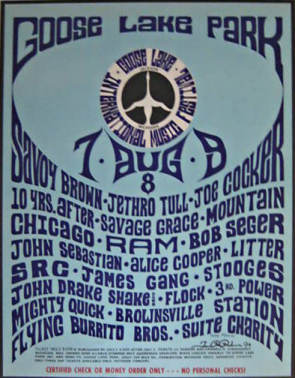
The Goose Lake International Music Festival was held August 7-8, 1970. It’s often mistaken as Grass Lake. Although, Grass Lake (the actual lake) is only two miles to the east. It was the closest community to the festival. The line-up included the James Gang, fresh off the release of Rides Again. James Gang and the Flying Burrito Brothers would have been worth the price of admission alone. My family had moved away several years before.
I’m descended from people who love to tell family stories on each other. And they were good at it. My mom used to tell the story of her younger brother, when they were kids, who climbed the water tower in Grass Lake and painted out the ‘Gr’ and the ‘L.’ This would have been in the late 1940s. On his way home from school, the cops stopped him and asked if he knew where “he” lived. Of course, he told them and continued walking home, knowing they would be there waiting for him. I never get tired of this story.


This is my grandma. She and my grandpa lived way out in the boonies. She was the one that would be summoned when a neighboring mother-to-be went into labor. She looked after the expectant mother until the doctor could arrive from town, sometimes delivering the baby herself – alive and kicking as she would say. My grandma was a hard working farm woman, but she knew how to have a good time. The photos are of her 50th wedding anniversary party in 1978 when she spontaneously got up with the band and sang “Wabash Cannon Ball.” I’m so proud of her.
My mom’s cousin, Bob and his wife, owned the first Dairy Queen on the corner by the railroad tracks in Grass Lake. Bob used to see my dad racing to work (at Ra-Tel, i.e. Radio/Television) in the morning, saying that sometimes our station wagon would even go a little air born over the tracks. I blame my dad when I’m running late.

My second great grandparents lost everything in the Chicago Fire of October 8, 1871. My grandmother was 7 months pregnant with a 20 month old toddler. They lived on the southwest edge, near where it started, and luckily took refuge even farther to the southwest (the fire was moving northeast). My great uncle was born in their church of refuge two months later on Christmas day. The toddler, my great aunt Blanche, grew up to be a dress designer for Marshall Field’s.
My third great grandmother, Harriet Gatch, owned two lumber mills in southern Michigan in the later 1800s. Decades ago, my dad’s cousin started a lumber business in Chelsea with the father of actor Jeff Daniels. My mom’s father, who came from farmers, started an electronics factory (after working at Ra-Tel) back in the 1950s. It was my first job out of high school. I assembled parts for Hammond Organ. I always wondered if any of them ended up in Paul Shaffer’s CheezeMaster 5000.
At one point, I started doing genealogies for people, for money. I quickly decided that it wasn’t for me because I was more interested in their family story than they were. One young woman had a great uncle who played violin in the orchestra of the Fox Theater in Detroit during it’s heyday. I was stinkin’ impressed with that, while she just stared blankly at me. Others wanted me to connect them to people more interesting than the “plain” folk they were actually descended from.
This is when it hit home to me that a person, first, has to have some context and interest in the bits…violin, orchestra, Fox Theater, Detroit history…to even begin to appreciate the information. The epigraph at the front of my book reads. “All facts are useful; it’s just the context that changes – Mr. Vincent Nigel-Murray.” If you’re not interested in the Fox Theater, then you move on to another topic that does interest you.
So, this is my attempt to explain why I feel the first chapter of my book, about the Gibson family, is so important and why I won’t remove it. And why I’ve turned down four publishers. You can only get to know Orville so much through the guitar production history of the Gibson company. But that’s what everyone’s interested in, isn’t it…the guitars. And I get it. I’m not discounting the history and innovations of their instrumental output. I’m trying to add to it.
Publishers say, ‘Oh, ok, sure, yeah, uh-huh.’ But after politely reading several chapters, they all inevitably ask if I could write more about the company and less about the family. One even wanted to turn it into a fictional storybook. He said, “Nobody cares if it’s true. This is what people want to read.” *Sigh* There goes my years of hard earned cred and here comes my future as a publisher’s circus monkey. Not.
Remember, I’m not a guitar person. Contact any number of makers, players, writers and collectors for that information. I’m a historian and a genealogist. I’ve been doing this since I was 16 years old. I’m interested in who people are, their path, their journey. What interesting details can be discovered about Orville that are beyond what the known material objects tell us?

How do you wrap that up into a marketable package so a publisher can present it to the book buying public for money! money! money! The answer is, you can’t. You have to take the long road, whether you believe it will sell or not, if you’re sincerely interested in who Orville was. My point is to document it. Just because we have precious little in the way of first hand information…and there’s a reason for that…(if this was the 1980s NFL, I’d be called for taunting right now, sorry)…it doesn’t mean we won’t be able to tell a more complete story. Or that it’s not important.
Orville is descended from farm folk, like me, with some really interesting characters in the mix. My guess is that the reason he invented and built his own stringed instruments is because nobody ever told him he couldn’t. There it is, Martin and Fender. I get it. I come from a long line of very creative, strong women. Nobody ever told me I couldn’t do or be anything…probably because they were all too busy rolling their eyes and shaking their heads. But still.
 A Biography of Orville H. Gibson