
Only Orvilles in the Building
…for the purpose of manufacturing, buying, selling and dealing in guitars, mandolins, mandolas, violins, lutes, and all other kinds of stringed musical instruments, and everything pertaining thereto, in all parts of the United States and Foreign Countries…
Articles of Association
Gibson Mandolin-Guitar Manufacturing Company, Ltd,
October 10, 1902
.
When the Gibson Guitar Company was signed into existence, one hundred twenty-one years ago today, they had no factory building, no machinery, no tools, no raw materials inventory, no materials inventory of any kind for that matter, and only one employee…Orville H. Gibson.
This is a good time to get something straight. The company was not founded by Orville. Trust me, it doesn’t change the Gibson production history. Everyone’s guitar is safe. Go check it in it’s case if you need to. We’ll wait…
The Gibson company was founded by Lewis A. Williams, a musician and music teacher; Sylvo Reams, a musician and music retailer; John W. Adams, an attorney; Samuel Van Horn, an attorney; and Leroy Hornbeck, an attorney and realtor.
The story goes that Lewis and Sylvo approached Orville with the idea of creating a factory for greater production. It’s my belief that the idea came from Lewis A Williams and that he persuaded the others to join him. Sylvo Reams was a classically trained musician that wouldn’t have been caught dead on the vaudeville stage where Orville, a self-taught musician, had performed since he was nineteen years old. And the attorneys…well, they’re attorneys.
The company bragged on their production capabilities and rightly so. It’s funny, what they called machine-made instruments back then, we would still consider hand-made today. But to say that the factory was created because Orville couldn’t keep up with orders is bullshit. After all the years of research I’ve done on the man himself, it’s my view that Orville could not have cared less about keeping up with orders. We’re all familiar with his response to a request from an entity on the east coast for one hundred mandolins, “One hundred mandolins, one hundred dollars each, one hundred years.” Yeah, this sounds like a guy who’s thinking “Holy crap! I need a factory!”
It still begs the question, why didn’t Orville start his own factory? My guess is that he was happy with the great success he had attained as an individual luthier and that paperwork, except for his most important notes, was best used to light his kerosene lamps. Secondly, I feel that at the time, the prestige lay with being an in-house luthier for someone else’s company. All of the prestige with none of the bookkeeping and no ham-fisted cabinet makers screwing up your intricate work. That is until you agree to teach your patented method to new employees…as soon as a factory building can be gotten.
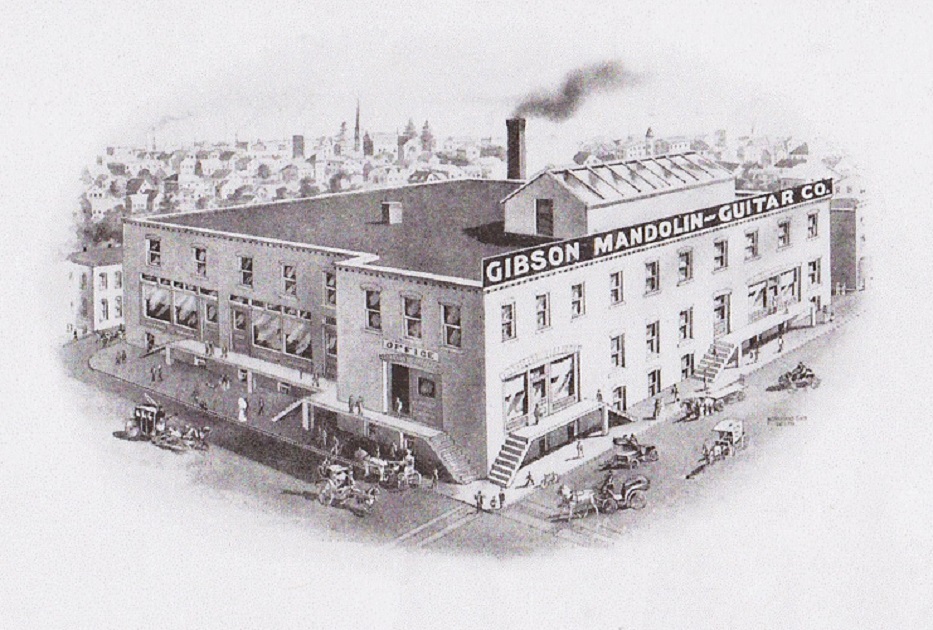
That happened around November 1, 1902. The five Gibson investors rented two floors of a brick Italianate building at 114 East Exchange Place owned by Benjamin Witwer, a baker who ran his own shop up on Main Street. The original Exchange Place building (on the (west) right side of the sketch above) was built by architect James Doyle in 1891. One of his most elaborate buildings in Kalamazoo, the Doyle Building, still stands on the old Main Street.
The left section (east) was added in 1897 and then remodeled to house Flexner Brothers Dry Goods in 1905. Thus the large glass display windows on the front. But at the last moment, Flexner’s decided to go with a building on Main Street. The Gibson company expanded into this section in 1906. The footprint of which is on the 1908 Sanborn map below.

.
There have been a lot of books written about Gibson guitars. And mandolins. And banjos. Not so much violins. These books include all kinds of models and styles and set-ups and customs. They were written by many knowledgeable, qualified authors. Walter Carter. Tom Wheeler. Tony Bacon. George Gruhn. In fact, if you want to know about really early guitars, Lynn Wheelwright is your man.
I, on the other hand, have a degree in Public History from Western Michigan University. It qualifies me to work at any historical park, building, museum or home. Or for any historical register. Anywhere that history is relayed directly to the public. But it’s the research I love. The thrill of the hunt. So, how does that qualify me to write a book about Orville H. Gibson? It’s because I’m writing about a person and their life in Kalamazoo before the company existed, not guitars. My guitar is brown with six strings. And it’s an Alvarez.
This book started as a term paper for one of my last classes at WMU. My professor, Tom Dietz, was the curator of research at the Kalamazoo Valley Museum. Our assignment was to pick a museum artifact and write about its purpose, use, intended customer and how it changed everyday life. I had already decided that I was not going to write about Gibson. Don’t get me wrong. I grew up in South Haven, a resort town forty-five miles west of Kalamazoo. We were certainly aware of Gibson’s activities and the celebrity comings and goings. I simply did not want my term paper to be tossed on an immense pile of Gibson papers and forgotten about.
As it turned out, Professor Dietz and I were standing in front of the Gibson exhibit at the museum when he told me that they had an Orville made mandolin in storage that was really quite unique (see the AUC mandolin entry under ‘Orvilles.’) I said, “What? You have what? A mandolin?” He made arrangements for me to see it, measure it and photograph it. I asked him if I had to mention the company in my paper since this mandolin was made prior to its existence. He said no and I had my artifact. Sort of.
As I began my research, all I could find were the same three paragraphs. No matter where I went on the internet. There was no way I could write a paper with the (rather sketchy) information in these three paragraphs. So, having been a genealogist since the age of sixteen and having researched my mother’s side of the family back to the early 1600s, I decided to approach Orville as if I were doing his genealogy. If this did not produce any results, I knew I would have to pick a different artifact. Fortunately, things started coming out of the woodwork. And I am still learning new things about Orville, his life and his work. I also write my book as if the company doesn’t exist, because it didn’t. Until it did.
So, you may ask, where’s my book already. It’s been sitting on a thumb drive for the last few years. I have said that the reason I passed on four publishers is because of the standard measly 8% author royalties. And, yes, while I feel the publisher is the one who should get only 8%, the real reason is that they all wanted to change my book in ways that I cannot accept.
I’ll be the first to admit that I’m a far better researcher than I am a writer. But as far as the content and direction, no, it all stays. I don’t care about “getting published.” I can do that myself. What I do care about is telling a complete and factual story to the best of my abilities. Pluma knows what I’m talking about.
There is a story I tell about a dream I had. Orville is sitting in an old timey wooden kitchen chair and he’s going on and on about everything. When I woke up, all I could remember is that at one point he put a finger to his forehead and pointed at me and said, “You have no idea how long I wracked my brain to think of something new and different.” That’s his story and I’m sticking to it.
.
This is Joyce Brumbaugh for “Only Orvilles in the Building”.
.
 A Biography of Orville H. Gibson